
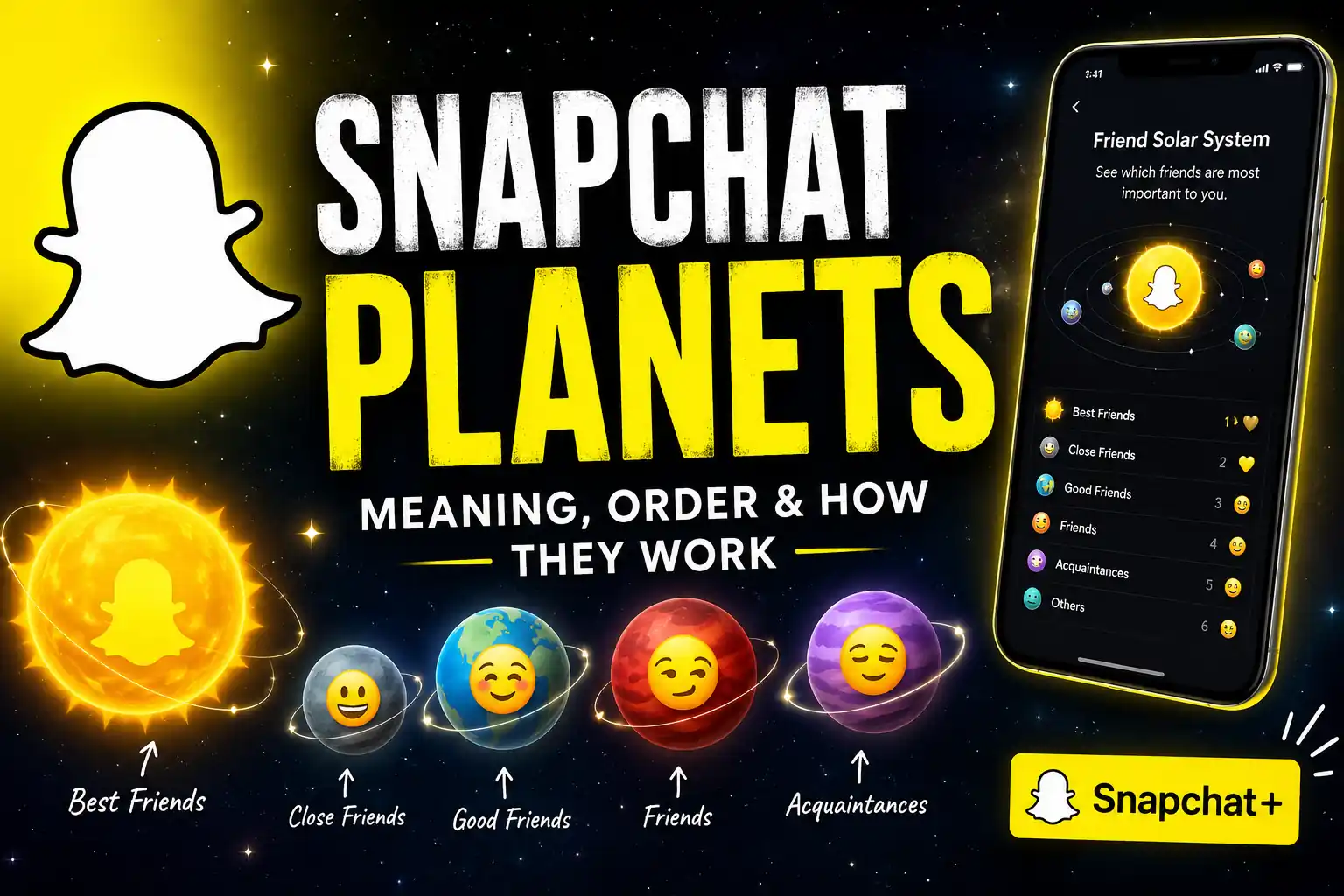
Snapchat Planets: Full Order, Meanings & How to See Yours
Snapchat Planets — officially called the Friend Solar System — is a Snapchat+ feature that turns your eight closest friends into planets orbiting around you. You are the Sun. Mercury = #1 best friend, Neptune = #8. The planet someone sees on your profile tells them exactly where they rank in your Snapchat life.
Key Facts at a Glance
Feature name: Friend Solar System (marketed as Snapchat Planets)
Requires: Snapchat+ subscription (starts at $3.99/month in the US)
You are: The Sun — your friends orbit around you
Total planets: 8 (Mercury through Neptune, matching the real solar system)
Rankings are NOT mutual — you can be someone’s Mercury while they’re your Neptune
Default: Off — you need to toggle it on in Snapchat+ settings
Pluto: Not included — it was demoted to dwarf planet in 2006
What Are Snapchat Planets?
Snapchat Planets launched as part of Snapchat+ and gave a creative visual twist to something the app already tracked: your Best Friends list. Instead of showing a numbered list, it turned your top eight friends into a solar system — with you at the center as the Sun, and each friend assigned one of the eight real planets based on how often you interact.
The idea is simple once you see it: the closer a planet is to the Sun in the real solar system, the closer that friend is to you on Snapchat. Mercury is right next to the Sun — that’s your #1. Neptune is billions of miles away — that’s your #8. The planets themselves show up as Friendmoji-style illustrations in the app, each with a distinct look, color, and set of hearts or stars floating around them.
Full Snapchat Planets Order — Quick Reference
| Planet | Best Friend Rank | What It Means | App Appearance |
|---|---|---|---|
| ☿ Mercury | #1 | Your absolute closest Snapchat friend | Red planet, red hearts floating around it |
| ♀ Venus | #2 | Your second closest friend | Light beige/cream planet, pink, yellow, and blue hearts |
| 🌍 Earth | #3 | Third closest friend | Blue-green Earth with the Moon nearby, red hearts |
| ♂ Mars | #4 | Fourth closest friend | Red planet, purple and blue hearts |
| ♃ Jupiter | #5 | Fifth closest friend | Orange-red striped gas giant, stars around it |
| ♄ Saturn | #6 | Sixth closest friend | Orange planet with a visible ring, stars |
| ⛢ Uranus | #7 | Seventh closest friend | Blue-green icy planet, no hearts — just stars |
| ♆ Neptune | #8 | Eighth closest friend | Dark blue planet, stars only — the most distant position |
What Each Snapchat Planet Actually Means
The planet order follows the real solar system exactly. Snapchat didn’t invent a new ranking — they mapped their friendship tiers onto something universally recognizable. Here’s what each position really means in plain terms:
Best Friend #1
Mercury
The top spot. You snap, chat, and interact with this person more than anyone else on Snapchat. Getting Mercury from someone means you’re genuinely their most active contact on the app — not just someone they occasionally message.
Best Friend #2
Venus
A hair below Mercury but still extremely close. Venus means you’re one of the most important people in someone’s Snapchat orbit — the gap between Mercury and Venus is usually small in terms of actual interaction.
Best Friend #3
Earth
Third place — solidly in the inner circle. Earth is where you’re clearly a close, consistent friend. The Moon floating next to it in the app’s illustration is a nice touch that sets it apart visually from the other planets.
Best Friend #4
Mars
Still in the top four, which means regular, consistent interaction. Mars is often the point where rankings start to feel competitive — close enough to be a best friend, close enough to care about the gap to Earth.
Best Friend #5
Jupiter
The outer planets begin here. Jupiter is the largest planet in the real solar system, which is a small irony — it’s the biggest planet assigned to the fifth-closest friend. Consistent interaction but maybe less frequent than the inner four.
Best Friend #6
Saturn
Recognized by its ring even in Snapchat’s simplified illustration. Saturn typically means you have a genuine friendship — you just don’t snap each other as relentlessly as the top five. A long-term friend who’s always around but not always active.
Best Friend #7
Uranus
One step from the edge. Uranus in Snapchat’s design is the only planet in the outer set with no hearts — just stars — which visually reflects the more distant, casual nature of the connection at this rank.
Best Friend #8
Neptune
The furthest planet — last on the list, but still in the top 8. Neptune means you’re still a recognized best friend, just the one someone talks to least frequently among their closest contacts. The dark blue color and stars-only design feels appropriately distant.
Real talk about Neptune: Being someone’s Neptune still means you made their top 8 — that’s something. But if you expected to be closer, it’s a clear signal to interact more consistently. Snapchat ranks shift as your activity changes, so Neptune isn’t permanent.
Best Friends Badge vs Friends Badge — What’s the Difference?
When you tap into a Friendship Profile on Snapchat, you might see one of two badges, both with a gold ring around them. They’re easy to confuse but mean different things:
| Badge Type | What It Means |
|---|---|
| Best Friends badge (gold ring) | The friendship is mutual — you are both in each other’s top 8 best friends. Tapping it shows where you are in their solar system. |
| Friends badge (gold ring, different label) | You have an active Snapchat friendship, but it’s one-sided — they’re in your top 8, but you may not be in theirs. You can still tap to see your planet in their system. |
The gold ring around both badges is what activates the planet reveal when you tap it. No gold ring means you’re not in each other’s visible best friends orbit.
Are Snapchat Planets Mutual?
This is the most misunderstood part of the whole system, and most guides skim over it. The answer is: no, they are not mutual.
Every Snapchat user has their own personal solar system. When you tap the badge on someone’s profile, you’re seeing their solar system — where you rank in their world, based on how they interact with their friends. It has nothing to do with how you’ve ranked them in yours.
- You could be someone’s Mercury while they’re your Neptune — meaning they interact with you more than anyone, but you have seven friends you talk to more than them.
- You could both be each other’s Mercury — that’s a Best Friends badge with mutual top ranking, which is the “we talk every single day” scenario.
- You could have a Friends badge instead of Best Friends, meaning the ranking exists but isn’t mutual at all.
This matters for relationships: If you see you’re someone’s Neptune and expected to be their Mercury, that’s real information — you might be investing more in the friendship than they are, at least in terms of Snapchat activity. Take it as data, not a verdict.
How Snapchat Decides Your Planet Ranking
Snapchat hasn’t published the exact formula behind the Friend Solar System. But based on how the broader Best Friends system has always worked, the ranking is determined by total interaction frequency across multiple activities:
- Snaps sent and received: The core driver — photos and videos sent back and forth carry the most weight.
- Snapstreaks: Maintaining a streak shows consistent daily contact, which reinforces your ranking.
- Chat messages: Text conversations within the app also count toward interaction frequency.
- Story replies: Replying to someone’s story registers as an interaction.
- Voice and video calls: These likely count, though Snapchat hasn’t confirmed their exact weight.
Rankings are dynamic — they update as your activity changes. A friend you’ve been chatting with every day for two weeks can move from Mars to Mercury quickly. A friend you haven’t snapped in a while will drift toward Neptune over time.
One thing Snapchat has confirmed: The Friend Solar System is off by default for first-time Snapchat+ subscribers. You have to manually enable it before any of this becomes visible.
How to See Your Snapchat Planet (Step by Step)
- Open Snapchat and make sure you have an active Snapchat+ subscription.
- Go to a friend’s profile. Tap their name or Bitmoji from your Friends list or from a chat.
- Look for the gold-ringed badge on their Friendship Profile — labeled either “Best Friends” or “Friends.”
- Tap the badge. An animation will play showing your position as a planet in their Friend Solar System.
- Read your planet. The name shown is your rank in their system — their #1 is Mercury, their #8 is Neptune.
If you don’t see a badge: Either you don’t have Snapchat+, the Friend Solar System feature isn’t toggled on yet, or you’re not in that person’s top 8 best friends. All three are possible.
How to Enable Friend Solar System
Because it’s off by default, you need to turn it on before your friends can see it and before you can check your own planet:
- Open Snapchat and tap your Bitmoji icon in the top-left corner to go to your profile.
- Tap the Snapchat+ banner or card to open your subscription feature management page.
- Find “Friend Solar System” in the list of features.
- Toggle it on. It can be turned off again the same way at any time.
How to Improve Your Snapchat Planet Ranking
If you want to move from Neptune toward Mercury in someone’s solar system, the answer isn’t complicated — you just have to actually interact more. Specifically:
- Send snaps every day — not just texts. Photos and videos drive rankings faster than messages alone.
- Keep your Snapstreak alive — streaks signal consistent daily contact.
- Reply to their stories — every reaction counts as an interaction.
- Chat regularly — quality is good but frequency is what the algorithm sees.
- Use voice or video calls on Snapchat rather than switching to another app for calls.
Consistency matters more than volume. Snapping someone 50 times in one day and then going silent for a week won’t hold your ranking the way steady daily contact will.
Why Isn’t Pluto in Snapchat Planets?
A fair question, and the answer is straightforward: Pluto isn’t in Snapchat Planets because Pluto isn’t officially a planet anymore. The International Astronomical Union (IAU) reclassified it as a “dwarf planet” in 2006, leaving exactly eight planets in the solar system. Snapchat’s Friend Solar System follows that classification, which is also why the feature covers exactly eight best friends — one for each real planet.
Pluto fans can take comfort that even Digital Trends noted its absence with a wry “Pluto gets left out again” — so at least the frustration is widely shared.
Do You Need Snapchat+ to Use Snapchat Planets?
Yes, completely. Friend Solar System is a Snapchat+ exclusive — there’s no version of it available to free Snapchat users. Without an active Snapchat+ subscription:
- You won’t see the gold-ringed badges on other people’s profiles.
- Your friends won’t be able to see their planet in your solar system.
- The Friend Solar System toggle won’t appear in your settings at all.
Snapchat+ pricing starts at $3.99/month in the United States as of 2025 — though pricing varies by region and plan type. Check the Snapchat app directly for the most current rate in your country, since it occasionally changes.
Besides Friend Solar System, Snapchat+ also unlocks Story Rewatch Indicator, Ghost Trails, custom app icons, Chat Wallpapers, and Priority Story Replies. If you’re also interested in checking how Story viewing works, understanding viewer order, or learning about privacy, a Snapchat Story Viewer guide can help explain these features. So if you’re a frequent Snapchat user, the subscription covers more than just the planet feature.
Frequently Asked Questions
What are Snapchat Planets?
Snapchat Planets (officially called Friend Solar System) is a Snapchat+ exclusive feature that assigns one of the eight solar system planets to each of your top eight best friends, based on how often you interact. You are the Sun, Mercury represents your #1 best friend, and Neptune represents your #8.
What is the Snapchat planets order?
Mercury (#1), Venus (#2), Earth (#3), Mars (#4), Jupiter (#5), Saturn (#6), Uranus (#7), Neptune (#8). The order follows the real solar system exactly — closer planets mean closer friends.
What does Mercury mean on Snapchat?
Mercury means you are someone’s #1 best friend — the person they interact with more than anyone else on Snapchat. It appears as a red planet with red hearts in the app.
What does Neptune mean on Snapchat?
Neptune means you are someone’s #8 best friend — the furthest position in their Friend Solar System. You’re still in their top 8, but they interact with their other seven best friends more frequently than with you.
Are Snapchat planets mutual?
No. Everyone has their own solar system. If you are someone’s Mercury, that means they interact with you the most — but you might rank them much lower in your own system. The planet you see when tapping someone’s badge is your rank in their world, not a reflection of how you’ve ranked them.
How does Snapchat decide which planet you are?
Snapchat uses overall interaction frequency — snaps sent and received, chats, Snapstreaks, story replies, and calls — to rank your top 8. The more you interact, the closer to Mercury you’ll appear. Rankings update dynamically as your activity changes.
How do I see my Snapchat planet?
Open Snapchat → tap a friend’s profile → find the gold-ringed Best Friends or Friends badge → tap it. Your planet in their solar system will appear. You need Snapchat+ and Friend Solar System toggled on.
What is the difference between Best Friends and Friends badges?
Best Friends badge = mutual — you’re both in each other’s top 8. Friends badge = one-sided — they’re in your top 8 but you might not be in theirs. Both have a gold ring and both let you tap to reveal your planet.
Do you need Snapchat+ to see Snapchat Planets?
Yes. Friend Solar System is exclusively a Snapchat+ feature. You need an active subscription to access it, starting at $3.99/month in the US. Without it, the badges and planet feature won’t appear at all.
Why is Pluto not in Snapchat Planets?
Pluto was reclassified as a dwarf planet by the International Astronomical Union in 2006, leaving the solar system with exactly 8 planets. Snapchat followed this classification, which is why the feature covers exactly 8 best friends.
How can I improve my Snapchat planet ranking?
Send snaps daily, maintain Snapstreaks, reply to stories, chat regularly, and use Snapchat for calls instead of other apps. Consistent daily contact raises your ranking faster than occasional bursts of activity.
Conclusion
Snapchat Planets is a genuinely clever feature — it took something Snapchat already tracked (your Best Friends list) and made it visual, personal, and just competitive enough to be interesting. The moment you tap that gold-ringed badge and see “Mercury” or “Neptune” pop up, you immediately know exactly where you stand. No ambiguity, just a planet.
The parts worth keeping in mind: rankings are not mutual, so the planet you see on someone’s profile tells you about their behavior, not yours. Neptune doesn’t mean you’re not friends — it means you’ve been less active with them than their other seven contacts. And everything is dynamic — interactions this week will shift rankings by next week.
If you’re deciding whether Snapchat+ is worth it partly for this feature, the honest answer is that it depends on how much you care about your ranking data. For heavy Snapchat users who already track streaks and best friends closely, the solar system visualization adds something real. For casual users, it’s a nice curiosity that won’t change how you use the app.
Either way, now you know exactly what every planet means, what the badges tell you, and how to read the system the way it’s actually designed — not just what position 1 through 8 looks like, but what it actually means for the friendship behind it.